June 17, 2026
by Tom Ewing
Charles Love finished the spring semester as Dean of Hobart Colege in upstate New York shortly before leaving to begin the 450 mile ride on the Virginia section of the Bikecentennial ride from Radford to Williamsburg. Love predicted that the ride would take him through “an area that is architecturally very interesting and one that I haven’t had an opportunity to see much of so that part will be exciting.” A photograph published in the Finger Lakes Times on July 22, 1976 showed Love’s bicycle ready for the drive to Radford.
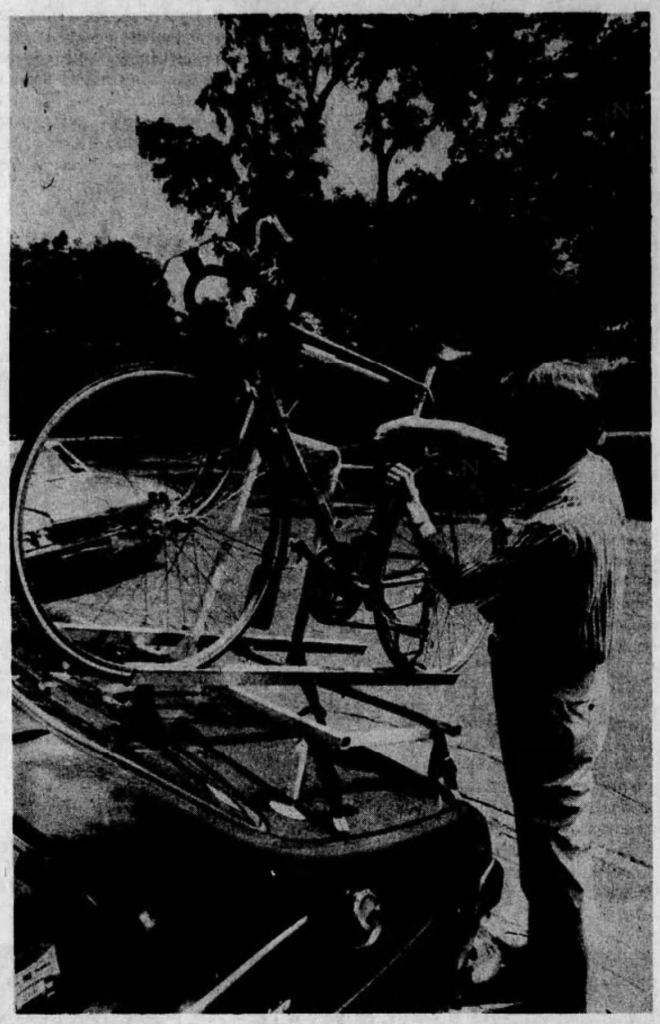
Two weeks later, Love telephoned a report that included accounts of historical sites along the route, including “a lot of Stonewall Jackson lore and memorabilia” in Lexington. “The two biggest advantages of this kind of a trip are the scenery and getting to know the other riders and seeing people in these villages and farms.”
In contrast to many other riders, Love took time to think more deeply about the factors that shaped the people and land along the route: “We’ll pass by an abandoned farm house or a tranquil field and being a romanticist, I begin to think about the different qualities that the scene evokes; but then as a realist it’s impossible to avoid the confrontation with the poverty that is also present. It’s sort of a two-edged feeling.”
Love’s encounter with Virginia history thus fall into two categories typical of the Bicentennial era: the well-documented locations for “traditional” Virginia history, from European settlement through the revolution to the civil war, and the everyday, but mostly undocumented, history of small towns and rural communities in the twentieth century. The town of Mineral, for example, had a population of 400 in 1920, and fifty years later, had the same population, as the industrial growth in the first part of the century stalled. Fifty years later, in 2020, the population is the same, even as the population of Louisa County has doubled, driven mostly by commuters to Richmond, Fredericksburg, or Charlottesville. The population of Charles City County rose by less than 20% from the Civil War to the Bikecentennial, and has changed little in the last fifty years. Henrico County, just to the west, which surrounds the city of Richmond to the north, saw the population increase by twenty times in the past century, from 18,972 in 1920 to 334,935 in 2020. These trajectories are connected to the history observed by Love, as agriculture experienced declines, small towns lost industrial and commercial resources, and populations grow in the suburbs.
In an interview published after his return to Geneva, Love recalled other highlights of the trip, including the small town of Mineral, a tour of Shirley Plantation, a meal in Charles City (23 feet above sea level with a population of 20), and the final round of farewells in Williamsburg on August 1. Asked to reflect on the meaning of the trip, Love stated: “The trip was good because it involved a change in perspectives. You got to thinking about primary concerns — your body, your bike, the next bike inn, the food, the scenery, the people. There was a schedule, but the trick was finding that the schedule encouraged freedom instead of preventing it.”

Leave a Reply